Parchment
A fast, minimal notebook with workspaces, collections, and a full public API. Built for humans and agents alike.
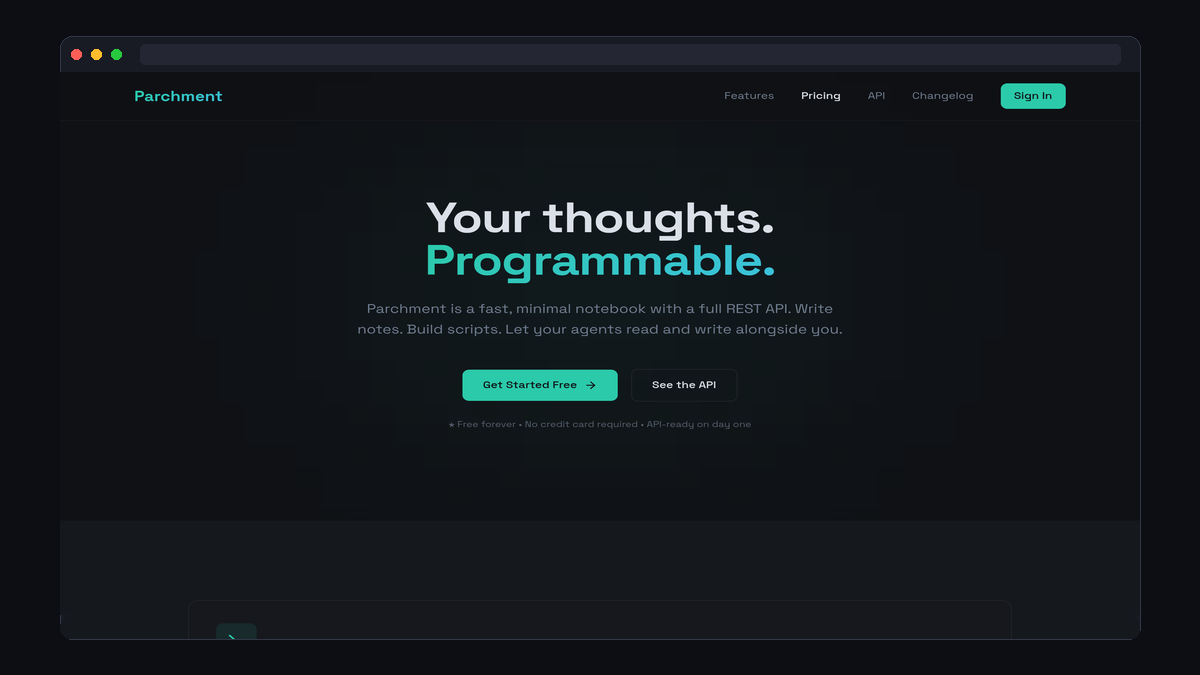
Note-taking apps that get in the way
Most note-taking apps are either too heavy (Notion, with its databases and AI features and marketing complexity) or too dumb (Apple Notes, which is fine until you need structure). There's a gap in between: something fast and minimal that still has real organization, real block editing, and a real API.
The API angle came from working with AI agents. When you're building automations, writing scripts, or running agents that need to read and write persistent notes, you need an app that exposes a clean REST API, not one that makes you scrape a UI or reverse-engineer a private endpoint.
Workspaces, collections, pages, blocks
Parchment is organized around a simple hierarchy: workspaces contain collections, collections contain pages, pages contain blocks. The structure is flexible enough for projects, research, meeting notes, checklists, and code snippets without needing a PhD in database design to set up.
- Block-based editing: headings, text, bullets, numbered lists, todo items, quotes, dividers, code blocks, and collapsible groups
- Public REST API: every action available in the UI is also available via API key. Create pages, append blocks, replace content, share pages publicly
- Page sharing: publish any page as a public read-only link, or share privately with specific email addresses
- Quick Notes: a system collection that's always there, can't be deleted, works like a scratchpad
- Offline support: IndexedDB cache layer keeps the app usable when your connection drops
Built for agents, not just humans
The public API is a first-class feature, not an afterthought. Every operation the UI can do is exposed via a simple JSON POST interface. You can build scripts, automate research saves, have an AI agent write to a page during a session, or query your notes from anywhere.
The Hermes Agent skill for Parchment is published at theparchment.app, so any AI agent that knows to look for agent skills can discover how to use it automatically.
React, Supabase, self-hosted on Hetzner
Parchment is a React + TypeScript app with a self-hosted Supabase backend running on a Hetzner VPS. The choice to self-host Supabase was deliberate: full control over the database, no per-row pricing surprises, and the ability to run separate production and staging environments on the same server.
Every feature was built iteratively with AI doing the implementation while the product direction, UX decisions, and architecture choices came from real use. The result is a codebase that's been through multiple refactors, a full offline-cache layer, a security audit, and a live API surface.
Want to try it?
Parchment is live and free to use. Sign up at theparchment.app. If you're building something that needs a note-taking backend with an API, it might save you some time.
Open Parchment →